Lakefront vs. Lake View: Understanding Property Categories Around Arenal
Lakefront vs. Lake View: Understanding Property Categories Around Arenal
Real estate listings around Lake Arenal use the words "lakefront" and "lake view" interchangeably and inconsistently, which is a problem because they are not the same thing — legally, practically, or financially. The distinction matters more here than at most North American lakes because Lake Arenal is an artificial hydroelectric reservoir governed by a specific legal framework that differs both from ocean-front coastal regulations and from how natural lakes are typically owned in Canada or the United States.
This article walks through what each property category actually means at Lake Arenal, what the legal background is, what the practical day-to-day differences are, and what questions to ask of a listing agent before assuming a "lakefront" property gives you what you imagine it does.
The 550-meter line: the single most important legal fact
Lake Arenal as it exists today is a man-made reservoir. The original natural lake was tripled in size when ICE — Costa Rica's Instituto Costarricense de Electricidad — built the Sangregado Dam at the southeastern end and finished it in 1979 as part of the country's largest hydroelectric project. Per Wikipedia's Lake Arenal entry, all land below the 550-meter elevation line was expropriated by the Costa Rican government as part of the project.
That single sentence is the most important legal fact about lakefront real estate at Arenal, and it is almost never spelled out in listing materials. Translation: the lake itself, plus the strip of land between the water's edge and the 550-meter elevation contour, is not privately owned. ICE manages it. Private property at Lake Arenal begins, by definition, at or above the 550-meter line.
This is similar in spirit to Costa Rica's Maritime Zone Law for ocean-front property, but the legal framework is different. The Maritime Zone Law (Law 6043) governs the 200-meter strip along ocean coastlines and creates a concession system for the inland 150 meters. Lake Arenal does not fall under that law because it is not a coastal zone. Its shoreline is governed by ICE's project-specific expropriation and ongoing administrative authority over the reservoir.
What that means in practice for a buyer:
- You cannot own the actual shoreline of Lake Arenal. No exceptions, regardless of what a listing claims.
- You can own property whose lower boundary touches the ICE-managed strip — what gets called "lakefront" in real estate language.
- You cannot build private docks, boat ramps, or permanent water-access structures into the lake without specific ICE permits, and those permits are not routinely granted.
- Public access to the shoreline is, in principle, preserved across the 550-meter zone — though in practice, access depends on whether there is a road, trail, or right-of-way reaching the water from outside private holdings.
What "lakefront" actually means at Lake Arenal
In the local real estate vocabulary, "lakefront" describes a property whose lower boundary abuts the ICE-managed strip — that is, a property that you can walk through to get to the water without crossing anyone else's private land. The water itself remains public; the strip between your title boundary and the high-water mark is also not yours to use exclusively. But the property has direct walking access to the lake, no neighbor between you and the water, and an unobstructed sightline to the surface.
The legal title for a "lakefront" property in this sense is normal fee-simple ownership — the same kind of titulado property you would buy anywhere inland in Costa Rica. There is no concession framework, no rental relationship with the government, no 20-year renewal clock. You hold full title to the land you occupy.
What you do not have, despite the term:
- A private beach. The shoreline is technically public, even though in many practical settings the lack of road access keeps it functionally private.
- A right to install a permanent dock. Most "lakefront" homeowners use floating docks, which sit at the public shore and are removable. These are tolerated; permanent piers are not.
- The right to fence to the water. Property lines stop at the 550-meter contour. Fences cannot extend into the ICE strip.
What you do get:
- Direct walk-down access to the water, often via a path or stair.
- Unobstructed lake views that cannot be lost to future development between you and the water (because that land is not privately owned).
- A meaningful resale premium — typically 30–60% over comparable lake-view-only properties, depending on the specifics of the access and the view orientation.
What "lake view" means and how it differs
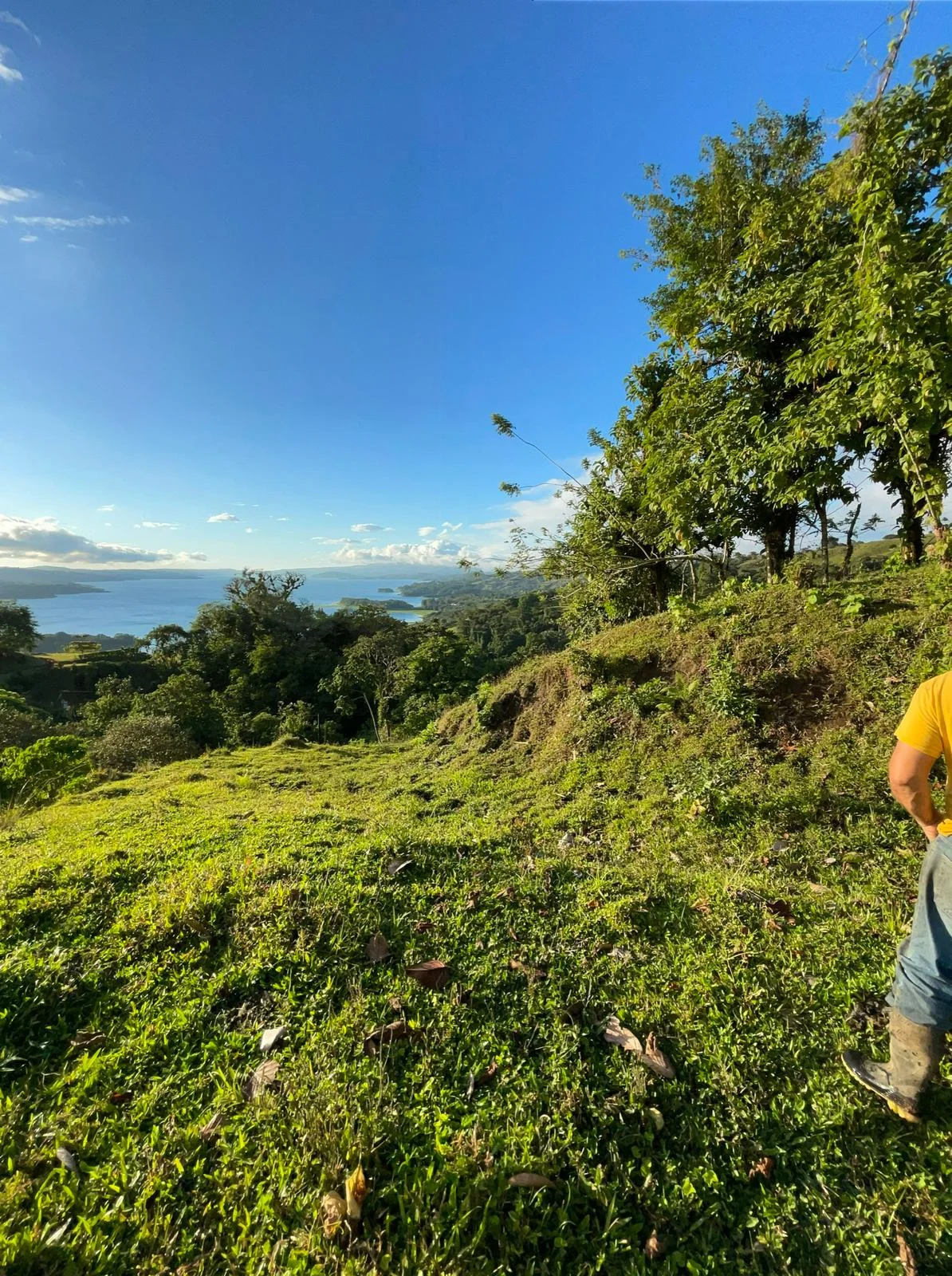
"Lake view" properties sit somewhere up the slope, above the 550-meter elevation line and usually well above it. They have views of the lake but no walking access to the water without going through a road, public access point, or another property's right-of-way.
This category covers a much wider range than "lakefront" does, and the variation in actual view quality is enormous. A 600-meter-elevation property with a clear southern aspect over the lake's eastern bay is fundamentally different from an 800-meter property whose lake view is partially blocked by a ridge to the south. The phrase "lake view" can describe either.
The practical filters that separate good lake-view from bad lake-view properties:
| Factor | What to verify | Why it matters |
|---|---|---|
| Aspect (compass orientation) | Property faces south, southwest, or west toward the lake | North-facing properties get the lake view but lose afternoon sun and warmth |
| Elevation relative to lake | 200–500m above the lake surface is typical | Higher = better views but more wind exposure; lower = less wind but potentially more cloud cover |
| Intervening topography | No ridge between property and shoreline | "Lake view" with a ridge in the way means the lake disappears in cloud weeks at a time |
| Vegetation control | Property's own setbacks plus neighbor's tree growth pattern | A cleared view corridor in 2026 may be closed by 2030 if the downhill neighbor lets a row of cypress grow |
| Distance to the lake | Less than 1 km is typical "close lake view"; 1–3 km is common; further than 3 km is "view of distant lake" | Affects perceived intimacy of the view and resale value |
A well-positioned lake-view property at 600 meters elevation with a clear southwestern aspect can have arguably better daily views than a marginal lakefront property — wider field of vision, less wind exposure, more usable outdoor terraces. This is why the lakefront premium is not always justified, and why some experienced lake-region residents actively choose lake-view over lakefront.
Lake access without lakefront title: the often-overlooked option
A category that most listings do not explicitly name but that is functionally important: lake-view properties with access to the water through a separate easement or community-shared waterfront.
Several gated developments around the lake — particularly on the western and northwestern shores — own a strip of "lakefront" land collectively, then grant access rights to every property owner in the development. Each owner has a private home with a lake view, and shared access to a waterfront amenity (path, dock, beach area). This structure costs less than buying a true lakefront property, gives you the lake access most lakefront owners actually use, and shares maintenance costs across the homeowners' association.
This category is worth specifically asking about when working with a local agent. The phrase to use: "Are there developments here with shared lakefront access for non-lakefront homes?" The answer is yes for several specific subdivisions, no for most independent properties.
Construction setbacks and what you can build
Whether your property is lakefront or lake-view, building regulations apply in both cases. The specifics:
Setback from the 550-meter line. Local Tilarán municipality and ICE both have setback requirements for new construction near the lakeshore. The exact distances vary by parcel but typically include a 15–30 meter buffer from the 550-meter contour where no permanent structures can be built. This is enforced and is a common source of permit denials when buyers assume they can build right to the water's edge.
Drainage and slope stability. The municipality requires soils studies and drainage plans for any construction on slopes greater than ~15%, which describes most lake-view properties given the topography. Plan on roughly $2,000–$5,000 for the studies before you can submit a building permit.
Tree-cutting permits. Even on private property, removing significant trees (defined varies by species and size) requires permits from MINAE — Costa Rica's Ministry of Environment. Buyers planning to "open up" a view by cutting trees often discover this rule late in the process. The conservative approach is to assume any clearing requires a permit and budget time for it.
Water source documentation. If the property has its own well, spring, or stream, water rights are owned by the State per Costa Rican law and must be permitted through MINAE. Existing permits are transferable with proper paperwork. Properties without verified water rights can face surprise issues post-purchase.
Mineral and riparian rights are owned by the State of Costa Rica and may only be exploited by obtaining a concession from the government. — Costa Rican property law summary, applicable to both ocean and freshwater shorelines.
What to ask before signing
If you are working a specific listing and the agent has called it "lakefront," the productive questions are short and concrete:
- Show me the survey plan. Specifically, where does the property's southern (or lake-facing) boundary fall in relation to the 550-meter elevation line? On the survey, the boundary should clearly show the property ends at or above this contour, with the ICE strip below it.
- Is there a path from the home to the water entirely on this property? If you have to cross a road or another parcel to reach the lake, the property is not truly lakefront in the conventional sense.
- What is the access from the road to the property? Long private driveways through ICE land are common and usually fine, but they can have permitting and maintenance complications. Verify the access right is documented.
- Are there existing dock or shoreline structures, and are they permitted? Unpermitted structures are common and create liability for the new owner. Either verify the permits or plan to remove the structures.
- What is the high-water history? ICE manages reservoir levels for hydroelectric output. The lake rises and falls seasonally and during drought years can drop several meters. Properties at the lower elevations of the lakefront band sometimes have docks that sit on dry land for months. Ask about the worst recent year.
- For lake-view properties, what is the easement situation for water access? If shared access is part of the property's value, verify the easement is registered in the public registry and not merely a verbal understanding.
Resale considerations
Both lakefront and lake-view properties hold value reasonably well in the Lake Arenal market, but their resale dynamics differ. Lakefront properties have a smaller buyer pool — only the most committed buyers prioritize direct water access — which means longer days on market when conditions are weak. Lake-view properties, particularly those with strong aspect and protected sightlines, have a broader buyer pool and tend to move faster but at lower price points.
Per the broader Costa Rica market context — Coldwell Banker's December 2025 update — properties closing 5–10% below asking is the norm in 2026, with stale listings closing 20–30% lower. Lake Arenal magnifies these dynamics in both directions: the lakefront premium can be amplified for properties priced realistically, and discounted dramatically for properties that have lingered.
The pragmatic advice for buyers thinking ahead to eventual sale: do not overpay for a marginal lakefront property whose access is awkward or whose dock situation is contentious. Pay up for clear, well-documented lakefront access on a property whose survey unambiguously shows the boundary, or buy a strong lake-view property at a meaningful discount to lakefront pricing. Mediocre lakefront is the most expensive resale category at Lake Arenal precisely because it has all the cost of a lakefront property and none of the appeal that justifies the premium.
Sources
- Lake Arenal — Wikipedia (history, ICE creation, 550m expropriation)
- The Making of Lake Arenal — Quatro Legal
- Owning Concession Property in Costa Rica — RE/MAX Ocean Surf & Sun
- Understanding Property Laws with Creeks in Costa Rica — CRIE
- Coldwell Banker Costa Rica December 2025 Report
- Ministerio de Ambiente y Energía (MINAE) — Costa Rica Environment Ministry