Lake Arenal vs. Beach Properties: An Honest Comparison
Lake Arenal vs. Beach Properties: An Honest Comparison
Lake Arenal and Costa Rica's Pacific beach towns are both legitimate options for North Americans considering relocation. They are not, however, comparable in any meaningful sense — they are different products that happen to share a country. The marketing tendency to position them as alternatives ("which is right for you?") obscures the fact that the daily life is different in almost every measurable way: the climate, the social rhythm, the food culture, the tourist density, the cost structure, the buyer profile, and the eventual exit.
This article walks through what daily life actually looks like in each, compares the practical factors most buyers undervalue when shopping, and offers an honest framing for which type of buyer should consider which.
Climate: the single biggest difference
Pacific Costa Rica beach towns — Tamarindo, Nosara, Manuel Antonio, Jacó, Santa Teresa — sit at sea level on tropical coastlines. The dry season (December–April) is hot and beautiful with low humidity. The green season (May–November) is hotter and wet, with humidity often above 80%. Air conditioning is mandatory year-round in most homes; without it, the indoor temperature in green season makes computer work, sleep, and meal preparation unpleasant.
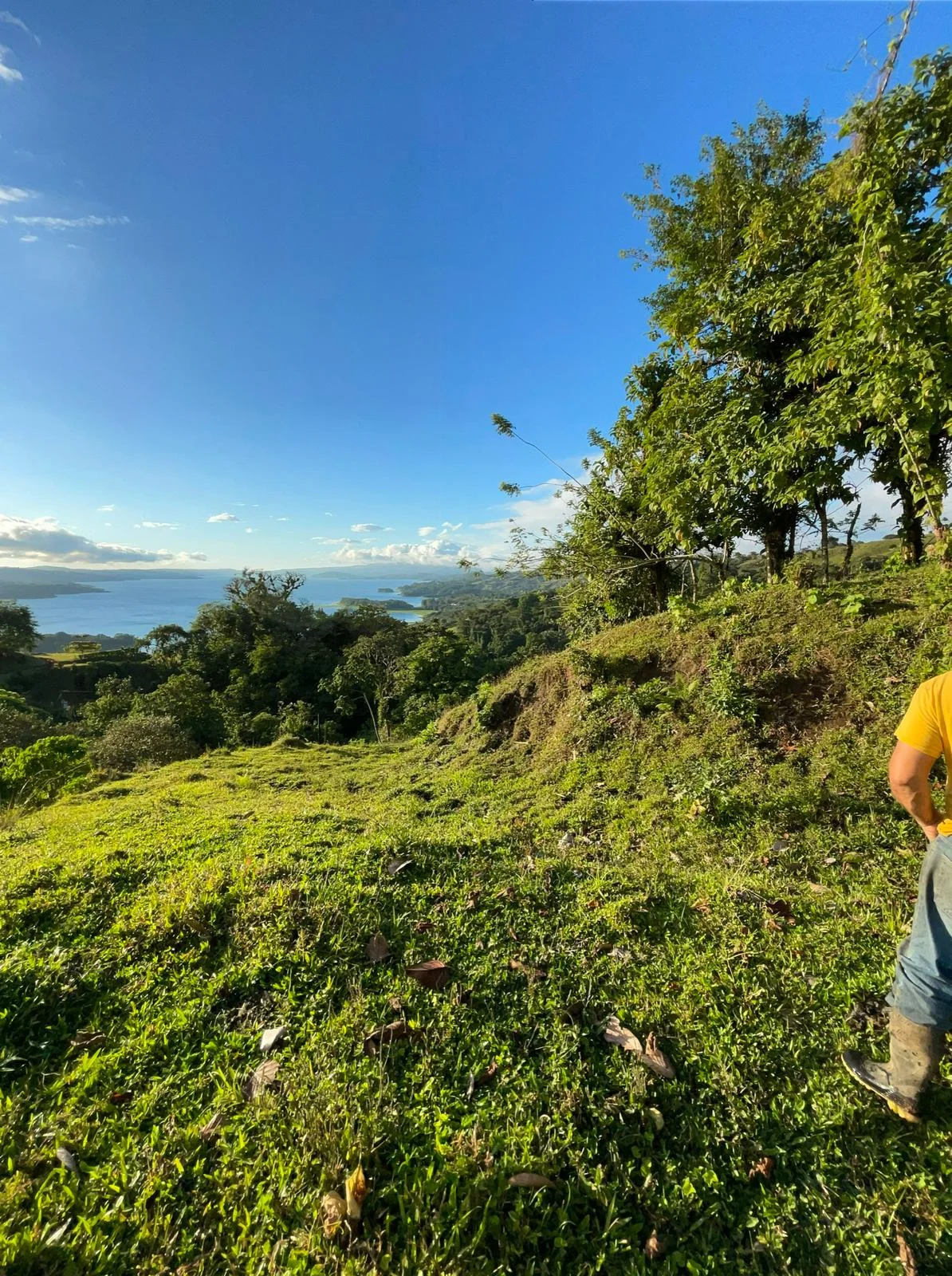
Lake Arenal sits at roughly 540 meters of elevation in the Tilarán mountains. Average temperatures stay in the 70–80°F band year-round. Air conditioning is rarely needed. Wind is the dominant atmospheric feature from December through March on the western shore. Humidity is moderate year-round and never punitive.
The downstream effects of this difference compound everywhere. Coastal homes have higher utility bills, faster wear on metal and electronics from salt-air corrosion, more frequent painting cycles, and shorter typical lifetimes for major systems. Lake Arenal homes have lower utility bills, slower aging, and outdoor terraces that are usable year-round at any temperature.
None of this makes one objectively better. People who genuinely love a tropical beach climate find Lake Arenal too cool in December evenings (the lake-region trade winds drop overnight temperatures to 60°F, occasionally lower). People who prefer temperate climates find Pacific coast summers exhausting.
Daily rhythm and density
Pacific beach towns operate on a tourism calendar. The week revolves around tourist arrivals and departures, sunrise and sunset, swell schedules, and the rhythm of high-season versus low-season pulses. Restaurants and shops are heavily oriented toward visitors. The expat population is more transient than it looks — many residents are part-time, returning home in summer or winter.
Lake Arenal operates on a residential calendar. The week revolves around the Tuesday market in Tilarán, the Sunday feria, weekly social events at expat-operated venues, and the slower pace of a small town where the same vendor sells you produce every week and the same gardener has worked for the same families for years. The expat population skews more residential and more long-tenured.
Practical translation: walking into a coastal town on a Tuesday in March, you are surrounded by tourists. Walking into Nuevo Arenal on the same Tuesday, you are surrounded by neighbors. Both have their appeal; they are not the same experience.
Food and groceries
Pacific coast food culture is heavily international, driven by tourism. Tamarindo and Nosara have surprising restaurant variety — Italian, Japanese, Thai, French, vegetarian, raw-food, juice bars — at price points 20–40% above Costa Rican averages. Grocery shopping is dominated by the larger supermarkets carrying imported goods at coastal premium pricing. Local farmers markets exist but are smaller and less central.
Lake Arenal food culture is split between the local feria economy and a smaller but high-quality expat restaurant scene. The Tilarán Sunday feria produces fresher and cheaper produce than any coastal market. Nuevo Arenal has perhaps a dozen serious restaurants — German bakery, Italian, French, Costa Rican, Argentine grill, Indian-fusion — with quality often surprising for a town this size, at price points roughly 30% below coastal equivalents. Groceries are simpler and cheaper if you cook from local ingredients.
The choice is not about which has more variety; coastal towns do. It is about which fits how you actually eat. Cooks tend to thrive in Lake Arenal; restaurant-explorers can find more options on the coast.
Wildlife and outdoor life
Both regions deliver on Costa Rica's biodiversity reputation. The specifics differ.
Pacific coast wildlife clusters around the marine ecosystem. Surfing, sportfishing, scuba diving, sea turtles, dolphins, whale-watching, mangrove tours, and dry-tropical-forest national parks (Manuel Antonio, Marino Ballena, Santa Rosa, Palo Verde) are the dominant outdoor activities. The wildlife you see most often is birds, monkeys, iguanas, sloths, and the seasonal turtles.
Lake Arenal wildlife is freshwater and montane-cloud-forest. Fishing for rainbow bass and tilapia in the lake itself, kayaking and stand-up paddling, hiking in Arenal Volcano National Park and the Monteverde cloud forest reserves an hour away, hot springs (the geothermal upside of the volcano), windsurfing and kiteboarding from December–March, horseback riding through farmland, and the chance — rare but real — of seeing tapirs and ocelots in the protected zones around the lake.
The biological richness is comparable. The activities are different. People who love the ocean find Lake Arenal limited. People who love forests, lakes, mountains, and adventure variety find Pacific coast tourism repetitive after a few months.
Social structure and community
Pacific coast expat communities are larger in absolute numbers. Tamarindo, Nosara, and Santa Teresa each have several hundred to several thousand expat residents. The community is socially fragmented into sub-groups — surfers, retirees, vacation rental investors, yoga and wellness, digital nomads, families with young kids — that overlap loosely. You can find your people; you may have to look across multiple sub-communities.
Lake Arenal's expat community is smaller — perhaps 600–1,200 across the full lake region — but more socially dense per capita. Most people know most other people. Sub-groups exist but overlap heavily because the absolute numbers are small enough that everyone shows up at the chili cookoff. The community has a more village-like quality.
For some people, the village structure is appealing — predictable, supportive, easy to integrate into. For others, it is suffocating — limited social variety, drama amplified by social density, harder to maintain anonymity. Both responses are common and there is no objective answer about which is better.
Cost of living, honestly compared
| Category | Pacific coast (Tamarindo/Nosara) | Lake Arenal |
|---|---|---|
| Comfortable couple budget | $3,000–$4,500/mo | $2,200–$3,000/mo |
| 2BR home rental | $1,500–$3,000/mo | $700–$1,500/mo |
| Electricity (with/without AC) | $200–$400/mo | $45–$95/mo |
| Restaurant dinner for 2 (typical) | $45–$80 | $30–$55 |
| $400K home insurance V+D | $1,500–$2,200/yr | $1,000–$1,500/yr |
| Property tax | 0.25% of value | 0.25% of value |
| Healthcare (Caja + private) | $300–$500/mo | $300–$500/mo |
Lake Arenal runs roughly 25–35% cheaper than equivalent Pacific coast living for typical full-time residents. The differential is real but not enormous; both are dramatically cheaper than U.S. or Canadian retirement areas.
Real estate market structure
Coastal properties — particularly in Tamarindo, Flamingo, Playa del Coco, and Nosara — trade in a relatively liquid market. Guanacaste's days-on-market sits around 340 days as of early 2026, which is long by U.S. standards but the volume is high enough that good properties at fair prices do find buyers.
Lake Arenal real estate is less liquid. The buyer pool is smaller, properties tend to take 12–24 months to sell at typical asking prices, and stale listings often need 20–30% price reductions to move. The illiquidity is the most significant downside relative to coastal markets — exiting is harder.
The compensating factor is volatility. Coastal Pacific properties saw 25–60% price appreciation during 2021–2023 followed by a correction. Lake Arenal properties moved less in both directions. Coldwell Banker's December 2025 update shows the broader market has moved firmly to buyer-favorable territory in both regions; Lake Arenal saw less of the prior runup.
Hurricane and natural disaster exposure
Costa Rica is generally outside the Atlantic hurricane track that affects Florida and the Caribbean. Pacific coast Costa Rica gets indirect tropical storm effects but no direct hurricane landfalls in modern record. Both regions experience earthquakes; both regions are in volcanic provinces.
The differentiator is local hazard. Coastal properties face tsunami risk (low probability, high consequence), king tides and shoreline erosion in some specific bays, and rainy-season flooding in low-elevation flood plains. Lake Arenal properties face the active-history Arenal volcano (currently dormant since 2010, monitored intensively) and slope-related landslide risk on steep parcels during heavy rains.
Both risks are insurable through Costa Rica's Coverage D framework at roughly 0.25% of property value annually. Neither is a deal-breaker for properly chosen properties; both are real and need to be priced into the decision.
Lake Arenal benefits from a temperate climate, reducing the need for air conditioning, which can be a major expense in hotter coastal regions. — Lake Arenal Properties cost-of-living guide. The compounding effect of lower utility, maintenance, and humidity-related costs is the single largest cost differential between the regions.
Who should choose what
The honest framework, after laying out all the factors above:
Choose Pacific coast living if you want: ocean access, more international restaurant variety, larger absolute expat community with sub-cultures to choose from, surfing or beach-related daily life, and you tolerate or enjoy hot/humid climate with year-round AC.
Choose Lake Arenal living if you want: temperate year-round climate without AC, lower utility and maintenance costs, freshwater and mountain outdoor recreation, smaller and more socially dense expat community, longer-term resident-driven culture rather than tourist-driven culture, and you accept that you are an hour-plus from Pacific beaches if that matters.
The category most often disappointed is buyers who choose one expecting the benefits of the other. Pacific coast buyers expecting cooler temperatures, slower pace, or village density often leave within two years. Lake Arenal buyers expecting beach access, restaurant variety, or surfing also often leave. Self-knowledge about what you actually want from a Costa Rican relocation is more important than financial analysis of either option.
Sources
- Guanacaste Costa Rica Real Estate Market Analysis 2026 — TheLatinvestor
- Costa Rica Real Estate Market Update December 2025 — Coldwell Banker
- Cost of Living in Costa Rica 2026 — Senderos CR
- Airbnb Profitability Analysis Costa Rica January 2026 — TheLatinvestor
- Costa Rica Property Insurance — NATIVU
- Lake Arenal Expat Community — Lake Arenal Living