Essential Questions to Ask Before Buying Land in Costa Rica
Essential Questions to Ask Before Buying Land in Costa Rica
Most North American buyers approach Costa Rican land purchases with the wrong template. They use the same questions and the same protections that work in the United States and Canada — and Costa Rica's legal framework, while broadly similar, has enough specific differences that the same diligence process will miss things. The most expensive surprises in Costa Rican real estate transactions are not bad properties; they are buyers who skipped the questions specific to this jurisdiction.
This article walks through the questions that actually matter, in roughly the order you would ask them, with enough context for each so you understand why the answer matters and what to do if the answer is the wrong one.
Question one: Is this property "titled" or "in possession"?
This is the single most important question and the one most often glossed over by listing agents.
"Titled" property — propiedad titulada — is what North American buyers expect. The property is registered with Costa Rica's National Registry, has a unique folio real identifier, and ownership transfers happen through a notarized public-deed process recorded in the registry. This is the safe category.
"Possession" property — derechos de posesión or propiedad en posesión — is something different. The current occupant claims ownership based on long-term continuous possession but has never formally registered title. This is common in rural Costa Rica, particularly in areas where land was farmed for generations before any formal registration system reached the area. Tres Amigos Realty Group's due diligence guide describes the issue: lawyers are expensive for humble farmers, so many smallholders never registered title even though their possession is uncontested.
Possession property is not necessarily a bad investment, but it is a different transaction type with much higher risk:
- You cannot get title insurance on possession property (no registered title to insure).
- Possession can be challenged by anyone with a competing claim, even decades later.
- Banks generally will not lend against possession property.
- Resale liquidity is much lower — many buyers will not consider possession property at any price.
- Converting possession to title is possible but typically takes 2–7 years of legal process, sometimes longer if disputed.
The first question to any seller or agent should be, in writing, whether the property is titled or in possession. If the answer is "titled," ask for the folio real number. If the answer is "possession," ask for the chain of possession evidence and assume the price should reflect the discount that this category warrants. If the answer is evasive or mixed ("partially titled," "titled with some unregistered improvements"), treat it as a possession property until proven otherwise.
Question two: What does the title search show?
Once you have confirmed titled status, the next step is a formal title search through the National Registry. Your Costa Rican attorney conducts this. The search reveals:
- Registered owner — verified against the seller's identification.
- Liens (gravámenes) — outstanding mortgages, tax claims, judicial encumbrances, or recorded easements.
- Boundary survey reference — the registered plano catastrado that defines the legal boundaries.
- Annotations — notations indicating lawsuits, claims, or restrictions on transfer.
- Tax status — whether municipal taxes (impuesto sobre bienes inmuebles) and the luxury home tax are current.
Any liens or annotations must be resolved before closing. The seller is responsible for clearing them, but the timeline can be weeks to months and is often a deal-killer if the seller cannot or will not. A clean title search is a non-negotiable closing condition; do not transfer money against an unresolved lien on the seller's promise to clear it later.
Question three: Where exactly are the property boundaries?
The plano catastrado is the registered survey plan defining the parcel's boundaries. It should be physically walked with a surveyor before closing. This sounds excessive; it is not. Costa Rican rural property boundaries are frequently inaccurate by 5–20% versus what is registered, particularly on parcels carved from larger family farms decades ago. Discrepancies surface only when neighboring development triggers a survey.
Specific things to verify on the ground:
- The boundary corners are physically marked and locatable.
- No structures (yours or a neighbor's) cross the legal boundary.
- Access roads to the property are within the parcel or have documented easements.
- Any creeks, springs, or watercourses are correctly noted on the plan.
- The total area on the survey matches what the listing claims.
If discrepancies appear, they need to be resolved before closing. Sometimes that means a new survey, registration of a corrected plan, and a small price adjustment. Sometimes it means the sale cannot complete until a neighbor cooperates. Either way, knowing before you close is far better than knowing after.
Question four: What is the water situation?
This is where many North American buyers underestimate Costa Rican due diligence. Water availability for new construction or expansion is governed by the carta de disponibilidad de agua — a formal letter from AyA (the national water utility) or the local ASADA (rural water association) confirming that legal water service can be supplied to the property.
Without a current carta de disponibilidad, you cannot get a building permit. With an outdated one (more than 12 months old in many municipalities), you cannot get a building permit either. The letter is property-specific and tied to current capacity.
Practical questions:
- Does the property have a current carta de disponibilidad? Has it been issued in the last 12 months?
- If the property is on a private well or spring, are the water rights formally registered with MINAE?
- If on an ASADA, has the seller been current on dues, and what are the connection fees if a new connection is needed?
- For lakefront or creek-side property, do shoreline setback rules affect what can be built?
Many properties advertised as "ready to build" turn out to be missing a current water letter, and the resolution can take months.
Question five: What is the zoning, and what can actually be built?
Costa Rica's land use regulations vary by municipality and have layered restrictions: zoning rules from the local plan (Plan Regulador if one exists), environmental restrictions from MINAE and SETENA, hydrological restrictions, and special protected-area overlays for lots near national parks or biological corridors.
The questions to verify:
- What is the parcel's land-use designation in the local plan? Is residential construction permitted?
- What is the maximum buildable footprint and height?
- Are there required setbacks from creeks, ridges, or property boundaries?
- Is the property in a SETENA-restricted environmental category? (Most slope properties are.)
- Does the property fall within a forest reserve, biological corridor, or watershed protection zone?
- Are there subdivision restrictions on the parcel?
The municipality can confirm zoning. SETENA can confirm environmental classification. A good local attorney handles both inquiries as part of standard due diligence; a poor one skips them and leaves you to discover the answer when your construction permit is denied.
Question six: What are the neighbors doing — and what are they likely to do?
Neighbors matter more in Costa Rica than in many North American suburbs because zoning is generally less prescriptive and enforcement is patchier. Diligence on neighbors:
- Walk the road. Note what types of structures and uses are nearby.
- Look for signs of upcoming development — staked-out parcels, recent clearing, surveyor's flags.
- Ask the surrounding property owners if any of them are considering selling or developing.
- Check whether agricultural or industrial uses on neighbor parcels would affect your peace, view, or air quality.
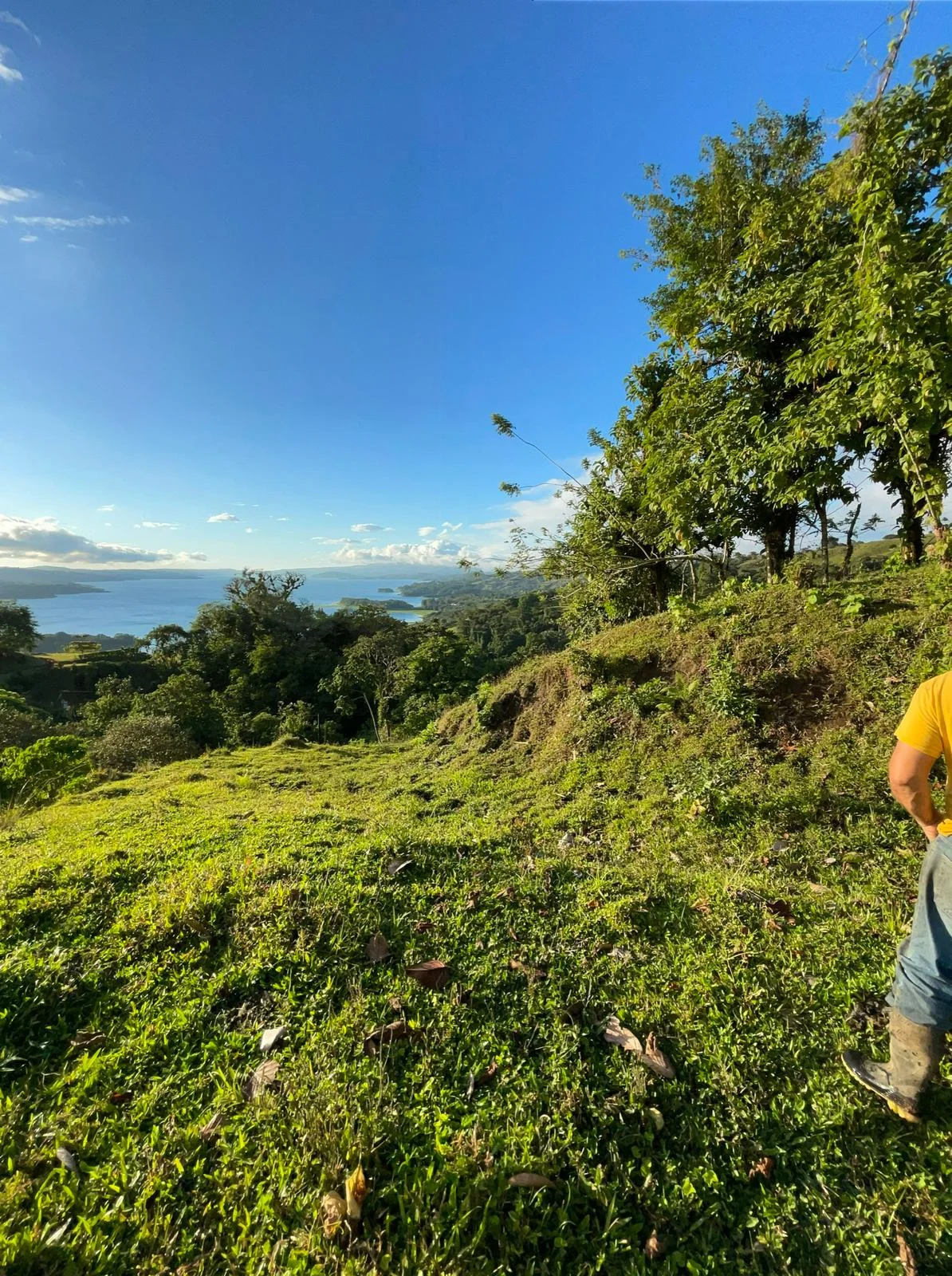
- For mountain or lake-view properties, identify the parcel directly downhill — that is the most important neighbor for your view permanence.
A property that is beautiful in 2026 can be unrecognizable by 2030 if the lot below clears for development or the lot above subdivides. View permanence is not legally protected in most of Costa Rica's rural areas; it depends on physical geography and neighbor restraint.
Question seven: What does the seller actually own, and are they actually selling it?
Costa Rica's property law has specific rules about marital property and corporate ownership that can complicate transactions. Three traps to verify:
If the seller is a married individual, both spouses must consent to the sale, even if the title is held in only one name. Costa Rican law treats family property as a marital asset by default. Do not accept "she'll sign at closing" without seeing both spouses' identification documents at contract signing.
If the property is held in a Costa Rican corporation (SA or SRL), the transaction can be structured either as a sale of the property or as a sale of the corporation's shares. Each has different tax implications. The buyer's attorney should review the corporation's status, including whether the corporation has any other assets, debts, or active operations that would transfer with it.
If the seller is an offshore entity or a non-resident foreign individual, the 2.5% non-resident capital gains withholding may apply at closing, and the transaction needs to comply with Costa Rica's anti-money-laundering reporting requirements. Verify the seller's legal status before contract.
Question eight: What does the property cost to own, beyond the purchase price?
Annual ownership costs are often understated by sellers eager to close. The realistic line items:
| Cost | Annual amount | Notes |
|---|---|---|
| Property tax (Bienes Inmuebles) | 0.25% of registered value | Paid quarterly to municipality |
| Luxury home tax (Solidario) | 0.25–0.55% on homes valued above ~$280,000 | Threshold adjusts annually; tiered scale |
| Insurance (V+D coverage) | ~0.25% of insured value | D coverage required for earthquake/volcano regions |
| Maintenance reserve | 1–2% of property value | Tropical climate is hard on buildings |
| Property management (if not resident) | $200–600/month | Recommended for absentee owners |
| HOA/community fees (if applicable) | $100–500/month | Gated developments only |
| Utilities (internet, electric, water) | $80–250/month | Climate-dependent |
For a $400,000 lake-region home, plan on roughly $5,000–$8,000 per year in unavoidable carrying costs alone, plus utilities. This is the figure to plug into rental yield calculations, not the gross rent.
Question nine: What is the seller's tax situation?
Sellers who are exiting Costa Rica or who held the property in a non-resident structure may have tax obligations that affect closing. Costa Rica's 15% capital gains rate is paid by the seller, but for non-resident sellers a 2.5% withholding is collected by the buyer at closing. Your attorney handles this, but verify it is built into the closing escrow so you are not personally liable for an unpaid seller obligation.
If the property is held in a corporation, the share-sale alternative shifts the tax calculation. Some sellers prefer this; some buyers should not accept it. The decision is fact-specific and should be modeled by the attorney, not assumed.
Question ten: Who is your attorney, and are they actually working for you?
The single most consequential due diligence decision is choosing your attorney, because everything else flows through them. The wrong attorney is one who:
- Was recommended by the seller or the listing agent, with no independent introduction.
- Bills a fixed flat fee that incentivizes minimum effort.
- Does not communicate in writing or refuses to provide written summaries of legal questions.
- Cannot or will not visit the property in person.
- Does not have direct experience with the specific municipality and region.
The right attorney is one who is independent of the transaction parties, charges by the hour or by phase with itemized invoices, communicates in writing, has handled multiple transactions in your specific region, and treats your due diligence as their own intellectual exercise rather than a checklist to mark off. Expect to pay $1,500–$5,000 in legal fees for a residential transaction, more for complex or commercial properties. A cheap attorney is the most expensive professional you will hire.
A specialized real estate attorney/notary is your most important ally — in Costa Rica, a notary public has the exclusive authority to draft and record the property transfer deed in the National Registry, and your attorney will conduct the title search, review all legal documents, and ensure the entire transaction is legally sound. — Costa Rica property purchase summary
The questions you should not skip even when you are excited
The pattern in failed transactions is consistent: a buyer falls in love with a specific property, the listing agent moves quickly to keep momentum, and the standard due diligence questions get truncated. Three months later the buyer is in dispute over the boundary, the water letter, the residual lien, or the spouse who never signed.
The discipline is to treat the ten questions above as non-negotiable, regardless of how good the property looks or how quickly the seller wants to close. A property that is genuinely good will tolerate four to eight weeks of due diligence without the seller pulling out. A seller who pressures faster timelines is signaling something — usually that competing diligence would surface inconvenient information.
The last sentence of every due diligence engagement should be: do you have any concerns about this transaction that you have not yet shared in writing? A good attorney's answer to that question — yes or no — is the most informative thing they will tell you.
Sources
- Due Diligence for Buying Land in Costa Rica — Tres Amigos Realty Group
- Title Search — Christopher Howard's Guide to Costa Rica Real Estate
- Buy Land in Costa Rica: Your Legal Guide — AG Legal
- Costa Rica Capital Gains and Property Tax Summary — PwC
- Buying Land as a Foreigner in Costa Rica (January 2026) — TheLatinvestor
- AyA — Costa Rica National Water Utility
- MINAE — Costa Rica Environment Ministry