A Complete Guide to Buying Property in the Arenal Region
A Complete Guide to Buying Property in the Arenal Region
This is the step-by-step procedural guide. If you have decided you want to buy property in the Lake Arenal region and you want to know what the process actually looks like from first scouting trip to keys in hand, this article walks through it in order. Other articles cover what to look for, where to look, and whether to look at all; this one assumes those decisions are made and focuses on execution.
Phase 1: Initial scouting (Months 1–3)
The first phase is reconnaissance, not transaction. Before any money commits, you need to understand the region well enough to recognize a good property when you see one.
Step 1: Two scouting trips, not one. Plan one visit in February or March (dry season, full inventory visible, agents engaged) and one in September or October (rainy season, honest test of properties). Each trip should be at least 5 nights, ideally a week. Stay in different parts of the region: a few nights near La Fortuna, a few near Nuevo Arenal, a few near Tilarán. The geography looks different from each base.
Step 2: Drive every road you might consider buying off of. The lake-perimeter Route 142 is paved but the secondary roads inland from it vary enormously. Some are gravel and well-maintained; some are degraded gravel that requires 4WD; some are private driveways with right-of-way complications. The road condition is a property characteristic, not a separate concern.
Step 3: Eat at the regular places. The town's restaurants are where you absorb the social rhythm. Drink coffee at the Nuevo Arenal cafés where expats gather in mornings. Have dinner at one of the German bakery's evening events. Visit the Sunday Tilarán feria. Join the Facebook expat groups (LOLA, Living Lake Arenal, Lake Arenal Community) and read posts for several weeks before your first trip.
Step 4: Meet two or three real estate agents independently. Do not commit to one agent in the first week. Different agents specialize in different regions, price points, and property types. Talk to three or four; pick the one whose communication style and knowledge depth fits you, and one whose recommendations match what you actually want, not what is most listing-saturated.
Phase 2: Property identification (Months 3–6)
Step 5: Build a written shortlist of criteria. Specific, measurable criteria. Not "lake view" but "unobstructed lake view to the south or southwest, property between 600m and 750m elevation, within 30 minutes of Nuevo Arenal, $300K–$500K, titled property only." Written criteria filter the agent's recommendations and prevent emotional shopping.
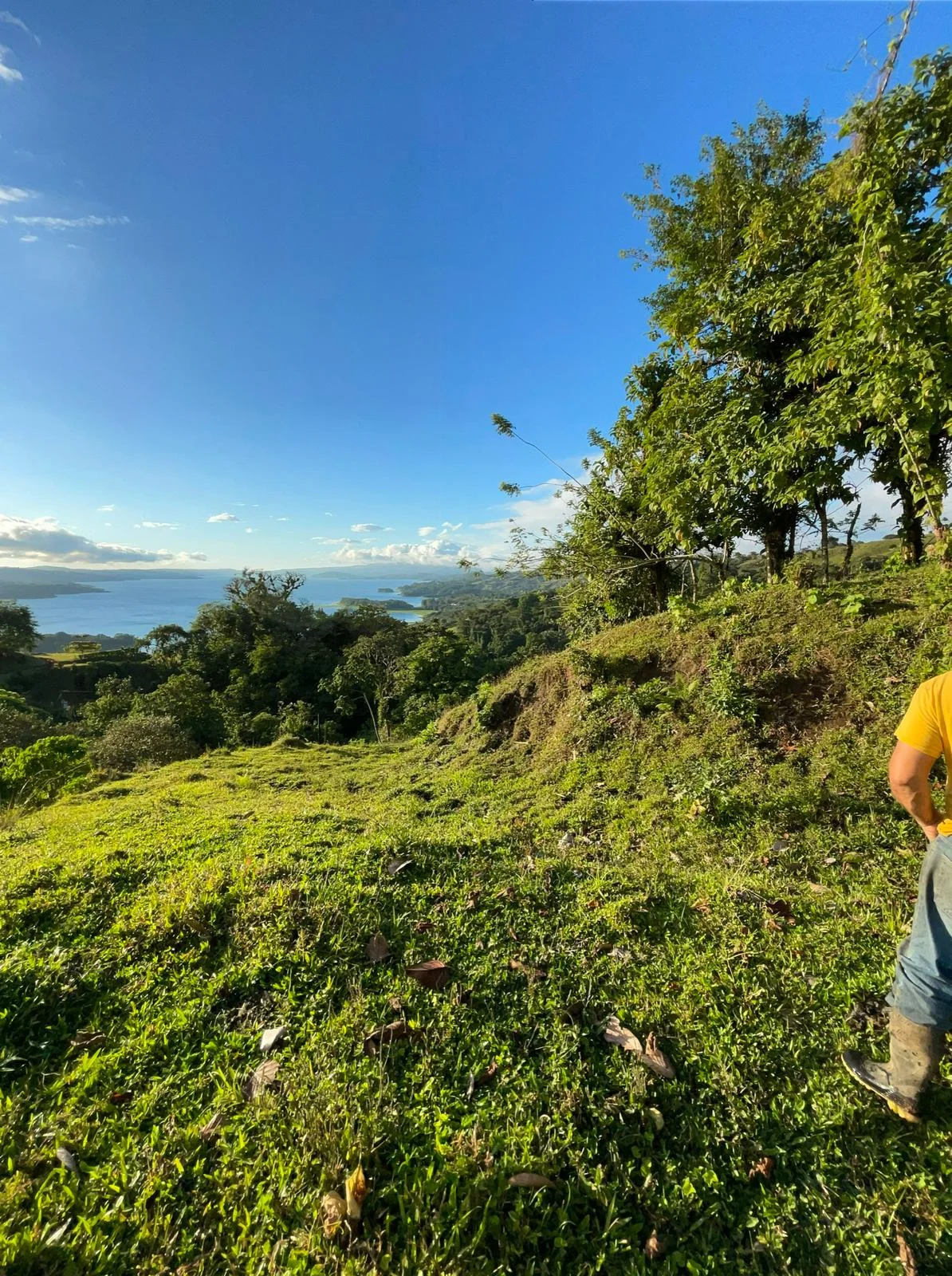
Step 6: Walk 6–10 properties. A productive shortlist of 4–6 candidates emerges from walking 8–12. Walk them at different times of day; ideally walk the leading candidates in different weather. Take photos of every angle, the access road, the boundaries, the water source, the neighbor relationships, and the main views from inside the home and from the property's exterior.
Step 7: Identify your top 1–2 choices. The discipline is to not make an offer in the first week of looking. Even if you find a beautiful property on day three, sleep on it for two weeks. Properties that survive that pause are the ones worth pursuing.
Phase 3: Pre-offer due diligence (Weeks 1–4 of escrow)
Step 8: Engage a Costa Rican attorney. Independent of seller and listing agent. Pay by the hour or by phase, not by flat fee. The attorney conducts the title search, reviews the registered survey, verifies water rights, and flags any pending issues. Cost: typically $1,500–$3,500 for a residential transaction, more for complex properties.
Step 9: Title search and registry review. Through the National Registry, your attorney verifies registered owner, current liens, easements, and any pending annotations. The result determines whether the property is safe to pursue. Tres Amigos' due diligence guide covers the standard checks.
Step 10: Survey verification. Walk the boundaries with a surveyor. Verify the registered plano catastrado matches the physical reality. Discrepancies need to be resolved before closing, often by ordering a corrected plan and registering it.
Step 11: Water and zoning verification. Confirm a current carta de disponibilidad de agua from AyA or the local ASADA. Verify zoning, environmental classification (especially SETENA for slope or sensitive properties), and any building restrictions on the parcel.
Step 12: Inspection. Hire an independent home inspector — typically an architect or engineer not affiliated with the seller — to walk the home with you and document condition. The inspection reveals systems issues, structural concerns, and maintenance needs that affect both your offer and your post-purchase budget.
Phase 4: Offer and negotiation (Weeks 4–6)
Step 13: Submit a written offer with contingencies. Costa Rican offers are usually structured as an oferta de compraventa with earnest money escrowed at a neutral law firm or escrow service. Standard contingencies: clean title, satisfactory inspection, water letter, attorney approval, financing if applicable. Earnest money in residential transactions is typically 5–10% of purchase price.
Step 14: Negotiate. The market in 2026 is buyer-favorable. Coldwell Banker's December 2025 report shows residential properties in Costa Rica typically close 5–12% below asking, with stale listings closing 20–30% lower. Reasonable opening offers in the Lake Arenal region in 2026 are 10–15% below ask for well-priced listings, more for stale ones. Sellers usually counter once or twice; both parties typically settle in the 5–10% below-ask zone for fair listings.
Step 15: Sign the contrato de compraventa. Once price is agreed and contingencies are written into the contract, both parties sign and earnest money goes into escrow. The contract sets a closing date, typically 30–60 days out.
Phase 5: Closing process (Weeks 6–10)
Step 16: Final due diligence completion. All contingencies resolve in this window. The seller clears any liens. Your attorney verifies the final title state immediately before closing. Any issues that arise become deal-modifying or deal-breaking events.
Step 17: Funds preparation. Wire funds to a neutral law firm escrow or to your attorney's trust account. Direct seller-to-buyer wires are not standard; everything routes through escrow until the deed is registered.
Step 18: Notary execution. A Costa Rican notary public — typically your attorney, who holds dual qualification as attorney and notary — drafts the public deed (escritura pública) transferring ownership. Both parties (or their proxies via power of attorney) sign in person or via authenticated remote signing.
Step 19: Closing costs. Standard closing costs in Costa Rica typically run 3–4% of purchase price total, split as: 1.5% transfer tax, 0.5% notary fees, 0.25% registration tax, plus stamps and registry fees. The split between buyer and seller is negotiable but most commonly the buyer pays roughly 60% and the seller 40%, totaling the full 3–4%.
Step 20: Registration. After execution, the deed goes to the National Registry for recording. Recording typically takes 4–8 weeks. During this period, you have legal possession but the registry has not yet updated; this is normal and not a problem.
Phase 6: Post-closing setup (Months 1–6 after closing)
Step 21: Utility transfers. Electricity (ICE/CNFL), water (AyA or local ASADA), internet (Kolbi or Liberty), and trash collection accounts move to your name. Some require in-person visits to local offices with passport and the registered deed copy; budget a half-day for the Tilarán municipality and utility offices in your first week.
Step 22: Insurance. Bind V+D coverage with a Costa Rican carrier. INS is the most common; private carriers like Mapfre, Lafise, and Oceanica are also legitimate. Effective immediately on closing — do not let coverage lapse.
Step 23: Property tax registration. The municipality needs to be notified of the ownership change so future tax bills route to you. Bring the registered deed to the municipal tax office. Pay the first quarter's tax to establish current status.
Step 24: Caja registration (if relocating). Begin your residency application if you are moving full-time. The 6–15 month approval window plus 3–4 month DIMEX wait means starting early matters. Visas Update's 2026 DIMEX guide covers current processing times.
Step 25: Establish local relationships. Find a gardener, a handyman, a cleaner if you need one, a property manager if absent. These relationships compound. The first few hires are often through expat-community recommendations rather than online searches.
Total timeline expectation
| Phase | Duration | Critical activities |
|---|---|---|
| Initial scouting | 3–4 months | Two trips, build criteria, identify agents |
| Property identification | 2–4 months | Walk properties, build shortlist |
| Pre-offer due diligence | 4–6 weeks | Engage attorney, title search, inspection, water |
| Offer and negotiation | 2–3 weeks | Written offer, counter, contract signing |
| Closing process | 4–6 weeks | Funds, notary, closing |
| Post-closing setup | 4–24 weeks | Utilities, insurance, taxes, residency |
| Total: scouting to keys | 9–14 months | Realistic, not optimistic |
Buyers who try to compress this timeline below 6 months almost always either skip due diligence steps or end up redoing work after closing because something was missed. The market in 2026 has more inventory than buyers; there is no rush.
Common process mistakes
- Using the listing agent as buyer's agent. The listing agent represents the seller. You need independent representation. Costa Rica does not have the dual-agency disclosure rules of some U.S. states; the conflict is structural and rarely surfaced.
- Skipping the inspection. Saving $400 on an inspection has cost buyers $40,000 in unexpected repair work many times. The inspection is not optional.
- Accepting verbal water-availability claims. The carta de disponibilidad must be in writing, current, and addressed to the property's specific cadastral identifier. "The neighbor said the water is fine" does not get you a building permit later.
- Wiring funds outside escrow. Direct buyer-to-seller wires before closing are how scams happen. Everything routes through neutral escrow until the deed is registered.
- Closing on a property in possession (not titled). Possession property is a different transaction with much higher risk. If you decide to do it, do it knowingly with appropriate price and legal structure — not by accident.
Sources
- Due Diligence for Buying Land in Costa Rica — Tres Amigos Realty Group
- Costa Rica Real Estate Market Update December 2025 — Coldwell Banker
- DIMEX Delays Costa Rica 2026 — Visas Update
- Buy Land in Costa Rica Legal Guide — AG Legal
- Costa Rica Property Tax and Capital Gains — PwC
- AyA — Costa Rica National Water Utility