The Best Time of Year to Buy Property at Lake Arenal
The Best Time of Year to Buy Property at Lake Arenal
Most guides will tell you the answer in one line: buy in green season when sellers are flexible. That answer is incomplete and, depending on your situation, slightly misleading.
Timing a Lake Arenal purchase is not a single question — it is five overlapping ones. When can you walk the land without slipping in mud? When can a contractor actually break ground? When does Costa Rican Migración assign your residency appointment? When are sellers reachable, and when have they flown back to Toronto? And when does the rest of your life — the lease ending, the pension starting, the kids finishing school — line up with a closing?
This guide answers each of those questions with current 2026 data, real institutional sources, and lessons from the Lake Arenal market specifically — not the Pacific coast clichés that most "Costa Rica buying" articles recycle.
Key takeaways
- Visit during both seasons before you buy. A property that feels idyllic in February is a different property in October. The dry season hides drainage, rutted access roads, and slope behavior under sun. Plan two trips, not one.
- The "best" month depends on what you are doing — viewing, negotiating, breaking ground, processing residency, or moving in. They do not align, and chasing one optimum can ruin another.
- Costa Rica's Migración is running 3–4 months behind on DIMEX issuance as of 2026, on top of a 6–15 month residency approval window. If your timeline depends on legal status, work backwards from that.
- Wind matters at Lake Arenal in a way it does not on the coast. December–March winds funnel through the western lake at 25+ knots almost daily. That is wonderful for kiteboarders and brutal for anyone living in an exposed cabin without thinking about it first.
- Construction season is roughly January through April. Outside that window, expect delays measured in weeks, not days, on every concrete pour.
Dimension one: climate timing — see the property in both seasons
Arenal has two seasons that locals refer to as verano (dry, mid-December through April) and invierno (green, May through November), with shoulder weeks bracketing each. The temperature stays around 22–28°C year-round at lake elevation. What changes is the rain and the wind.
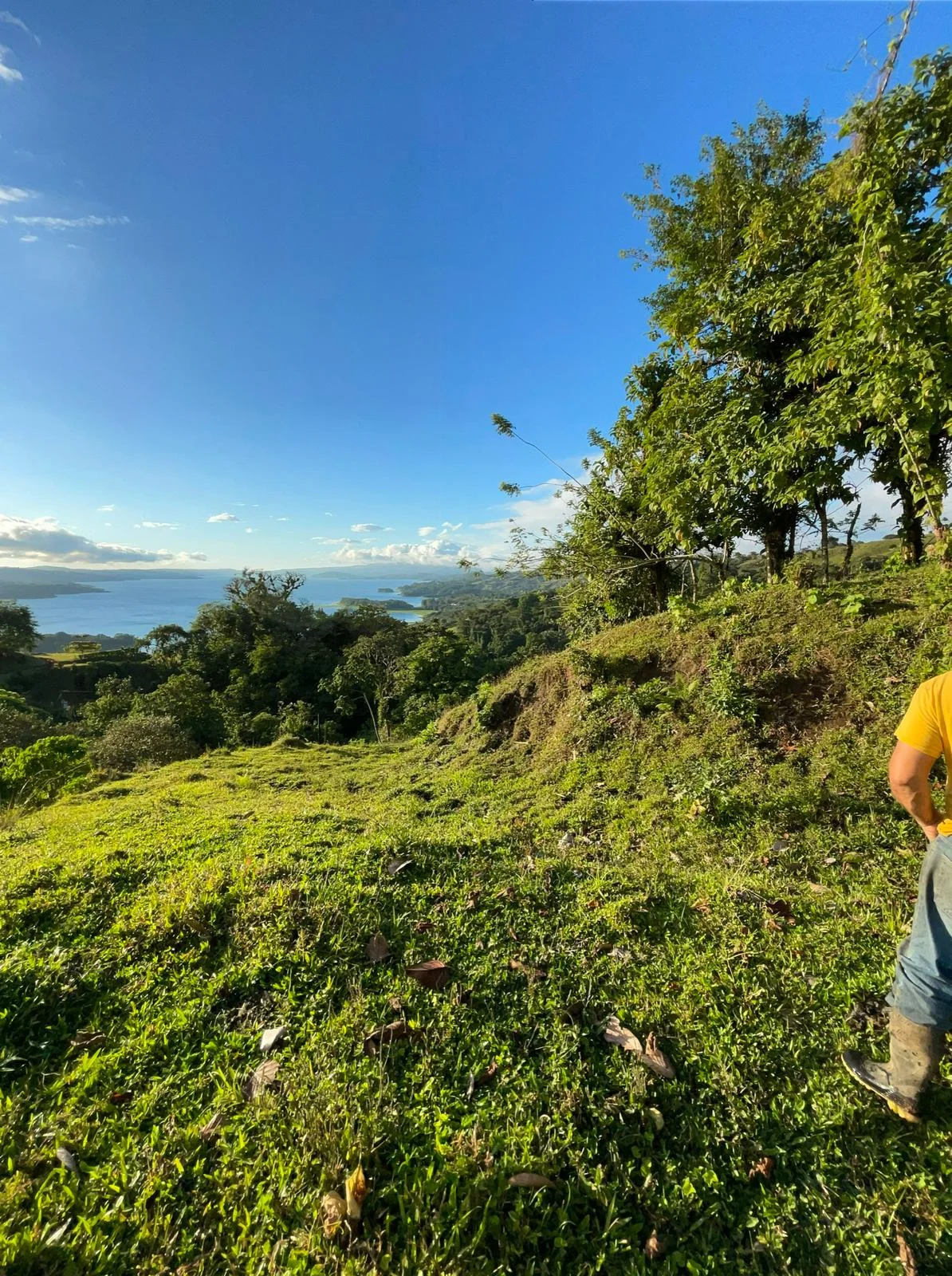
This matters because the property you are evaluating is not the same property in both seasons. In dry season, a steep gravel driveway looks scenic; in October, that same driveway becomes a runoff channel and your truck does not make it up. A deck with a "lake view" framed by a small ridge in March may have a wall of low cloud sitting on that ridge for weeks at a time during green season.
Practical advice from people who have done this: schedule one visit in February or March and one in September or October. February shows you the property at its most photogenic and lets you negotiate while the local market is busy with serious buyers. October shows you what the rainy months actually feel like — the road conditions, the humidity, the wind direction shifting, the sound of water moving across the property.
If you can only make one trip, pick green season. You will see the worst-case version of the property, and any compromise you make will be made with full information.
Dimension two: construction season — when contractors actually work
This is the dimension most North American buyers underestimate. Costa Rican construction is not paused by rain in the way builders elsewhere are paused by snow, but rain dictates schedule in ways that are very real.
Concrete pours, foundation work, exterior finishing, road grading, and septic installation all assume dry ground. Crews can and do work in green season, but the calendar slips. A 9-month build that started in January will close in early October. The same build started in May will, in practice, often slip to the following March or April.
A useful rule: if you intend to build, close the purchase by October at the latest, ideally earlier. That gives your architect November to finalize plans, your tramitador the holiday weeks to push permits through Tilarán's municipality, and your contractor a clean January start. Buying in March and breaking ground in May means a foundation pour in the rainiest part of the year.
If you are buying an existing home with no significant construction planned, this dimension matters less — but verify the property has working drainage, no obvious slope failures, and an access road graded for the wettest months.
Dimension three: wind season at Lake Arenal
This is specific to Lake Arenal and almost never discussed in generic Costa Rica buying guides. The lake is, by global standards, one of the windiest inland bodies of water on the planet during winter — winds blow with sailing-grade force roughly 90% of the time from December through March, with afternoon gusts above 25 knots common, and 40 mph events normal on the western side.
That makes the lake an international destination for windsurfing and kiteboarding, which is good news for rental yields if you buy on the western shore. It is also why every credible builder in the region orients new homes with the prevailing northeast wind in mind. A glass-walled great room facing northeast looks beautiful in renderings; in February it is a wind tunnel.
If you are evaluating properties between December and February, you will feel the wind at full force. If you are evaluating between June and August, you will not. Ask the seller — and any neighbor you can flag down — what the wind does on the property in January. Look at the trees: bent trunks tell you the answer regardless of what the seller says.
Dimension four: regulatory timing — residency, taxes, and the calendar
You do not need to be a Costa Rican resident to own property here. Foreign nationals can hold title in their own name with the same legal protections as Costa Ricans, with the narrow exception of land within 200 meters of the high tide line on the Pacific and Caribbean coasts (the Maritime Terrestrial Zone). Lake Arenal is freshwater and inland, so this does not apply — you can own outright.
That said, the timing of your residency application affects your buying calendar if you intend to live here, not just visit.
Costa Rica's General Directorate of Immigration (DGME) confirmed in early 2026 that processing delays for DIMEX residency cards have continued into 2026, with most categories now waiting 3–4 months for the physical card on top of a 6–15 month underlying approval window. Practical translation: from filing your pensionado or rentista application to holding the card in your hand, plan on roughly a year, sometimes more. Legal status remains protected during the wait, provided you can show proof of a scheduled or completed appointment, but functions like opening a long-term bank account, buying a vehicle in your own name, or signing a multi-year service contract become awkward without the card.
On the tax side, Costa Rica taxes capital gains on real estate at 15% of profit at the federal level, with a one-time election available at 2.25% for assets acquired before July 1, 2019 and sold for the first time. Non-residents can be subject to a 2.5% withholding at sale, collected by the buyer. Primary residences held more than two years are generally exempt. None of this is unusual by international standards, but the rules trip up sellers who closed five years ago without any tax planning.
The takeaway for timing: if you are buying with a five-year hold horizon and no plan to live in the property full-time, calendar the sale carefully. The two-year primary-residence clock runs from when you actually live there, not from when you closed.
Dimension five: market timing — and why prices are not the whole story
This is the dimension every other article focuses on. We will keep it short because the others matter more for most buyers.
Costa Rica's national real estate market entered 2026 in clearly buyer-favorable territory. Inventory is up roughly 15% across most regions, days on market for the average home are at around 376 days nationally — about 32% longer than 2024. Sellers in Guanacaste are closing at 5–10% below asking on average, and properties that have sat on the market for more than a year often trade 20–30% below original list.
The Lake Arenal market is smaller and less liquid than Guanacaste's coastal markets, so single-property data points dominate the headlines. Sellers here tend to be motivated for personal reasons — health, family in North America, age — more often than for market reasons. A serious buyer who shows up in green season with a clean pre-approval letter and a defensible offer has real leverage. The same buyer in February, competing with three other walk-throughs the same week, has less.
"Most sales in Guanacaste close at 5 to 10% below asking price" — and properties that have been listed more than a year often close 20–30% lower than their original price. Coldwell Banker Costa Rica market report, December 2025.
Putting it together: a month-by-month buyer's calendar
The five dimensions above pull in different directions. A simplified table:
| Activity | Best months | Why |
|---|---|---|
| First scouting visit | February–March | Sellers and agents present, dry roads, full inventory visible |
| Second scouting visit (verification) | September–October | Worst-case rain and access conditions; honest test of the property |
| Negotiating an offer | May–November | Fewer competing buyers, sellers more flexible, longer days on market |
| Filing residency application | As soon as documents are ready | 6–15 month approval, plus 3–4 month DIMEX wait — start the clock early |
| Closing on a build site | By October | Permits and design through holiday weeks, dry-season ground-break |
| Closing on an existing home | Any month | Less weather-sensitive once title and inspections are clean |
| Moving in | December–March | Easier for North American moves; coincides with best Arenal weather |
What Lake Arenal specifically demands of buyers
The Arenal region has personality, and that personality penalizes a few specific buyer behaviors more than other parts of Costa Rica.
Do not buy a property without driving to it in the rain. Dirt roads grade differently than they look. Some properties have a perfectly maintainable road in dry season and a 4WD-only ascent in October. Insurance for daily-use vehicles, contractor access, and resale value all depend on the road being usable year-round.
Verify water source. Lake Arenal sits at 540 meters of elevation in mountainous terrain. Some properties draw municipal water from AyA (the national water utility) or from local ASADAs (community-managed rural water associations). Others rely on private wells or spring-fed cisterns. None of these is automatically bad, but they have very different reliability profiles, very different transferability when you eventually sell, and very different costs to repair when something fails.
Understand the difference between Tilarán and Nuevo Arenal. The two main towns serve different purposes. Tilarán is the cantonal seat — municipality offices, the Banco Nacional branch, the regional clinic, the weekly farmers' market. Nuevo Arenal is smaller, more expat-dense, more restaurants and social density per capita, and slightly higher property prices because of it. About 300 of Nuevo Arenal's roughly 2,400 residents are expats from the U.S., Canada, Germany, France, and Nicaragua, which gives the town its distinctive bilingual character. Choosing between them is a lifestyle decision more than a financial one.
Check the road condition for your specific access route. Route 142 around the lake itself is paved and curving but well-maintained. The roads off Route 142 to individual properties vary widely. The Nuevo Arenal–Tilarán segment received infrastructure upgrades that improved travel times to Liberia airport, but tertiary roads inland from the lake remain a property-by-property question.
Frequently asked questions
Is the dry season really when prices are highest?
Yes — but the spread is smaller than most articles imply. Dry-season pricing reflects more competition among buyers, not necessarily higher seller asks. A motivated seller who has had the property listed since June will close at green-season pricing in February if you are the only credible offer. Conversely, a seller who lists fresh in January often holds firm because they expect dry-season demand to find them.
Should I close before or after my residency is approved?
You can close at any time — residency is not a prerequisite. The practical question is whether you want to be moving boxes into a property without a Costa Rican bank account, vehicle title, or local credit. Many buyers split the difference: close first, file residency the following month, and bridge the awkward 12-month gap with a notarized power of attorney to a local tramitador who can sign service contracts on your behalf.
How important is the windsurfing window if I am not a windsurfer?
More important than it sounds. Strong winds at Lake Arenal are a quality-of-life factor — they affect house orientation, deck usability in December–March, the noise level inside an exposed home, and the lifespan of outdoor furniture and screens. They also determine the property's rental appeal: western-shore homes near the kiteboarding launches command real premium rates from December through March, which materially changes the math on a property held partly as a vacation rental.
Is it cheaper to buy land and build than to buy an existing home?
Often, yes — on a dollars-per-finished-square-meter basis. The catch is the build itself. Costa Rican construction timelines are legitimately longer than equivalent North American builds. Materials are more expensive than they look once shipping and import duties are factored in. Skilled trades are good but limited in number locally, so quality contractors book months ahead. A sober expectation is 12–18 months from breaking ground to move-in, and a 15–20% contingency on the budget you are quoted up front. People who have done this twice usually advise first-time buyers to start with an existing home and renovate, then build the second time when they understand the market.
What is the worst month to begin a property search?
Late November and the second half of December. Many sellers are traveling, agents are reduced to skeleton crews, the municipality slows down before the holidays, and notaries are difficult to schedule. You can do reconnaissance — drive routes, check towns, eat in the restaurants — but expect that any decision-grade conversations will resume in the second week of January.
Concrete next steps
If you are reading this in early 2026 and thinking about a 2026 or 2027 purchase, here is a sane sequence:
- This quarter: book a February or March scouting visit. Spend at least five nights in the region, not three. Drive every road you might consider buying off of.
- If a property catches your eye: do not put a non-refundable deposit until you have walked it in green season. Earnest money in October, closing in November, move-in over the holidays is a perfectly good calendar.
- Begin residency paperwork early. Whether you are a pensionado, rentista, or inversionista applicant, the documents you need from your home country (FBI background check, apostilled marriage certificates, pension statements) take time to gather. Start them before you fly down for the second visit, not after.
- Engage a local attorney early — not at closing. A good attorney will walk an interesting property with you, run a title search, check the water source registration, and flag boundary or zoning issues before you have committed emotionally to the purchase.
- Ask the neighbors. The most useful information about a Lake Arenal property is rarely on the listing sheet. Walk to the nearest two or three houses and introduce yourself. People here will tell you what flooded last October, what the wind does, and which contractors are reliable.
The "best" time of year to buy at Lake Arenal is not a single month. It is a sequence of months arranged around the rest of your life — climate testing, regulatory paperwork, construction logistics, and personal timing — converging on a closing date that lets you actually live in the property the way you imagined when you started looking.
Done well, the process takes 12–18 months from first scouting visit to moving in. Done poorly, it takes either much less time and much more regret, or much more time and much more drift. The five-dimension framework above is the difference.
Sources
- Lake Arenal Windsurfing Conditions — Surf Magazin
- DIMEX Delays Costa Rica 2026 — Visas Update
- Costa Rica Capital Gains Tax — PwC Tax Summaries
- Costa Rica Real Estate Market Update March 2025 — Dominical Realty
- Coldwell Banker Costa Rica — December 2025 Report
- AyA — Costa Rica National Water Utility
- Lake Arenal Expat Community — Lake Arenal Living
- Costa Rica Road Conditions — Two Weeks in Costa Rica